
About
StrepTRN is a web portal for information regarding Streptomyces transcriptional regulatory networks. Currently, the website contains the binding events of Streptomyces coelicolor regulatory genes in S. coelicolor, and 16 other actinobacterial strains, as observed in the (multi)DAP-sequencing dataset by Augustijn et al. (2026) (hereby referred to as the original paper).

Methods
DAP-seq data processing
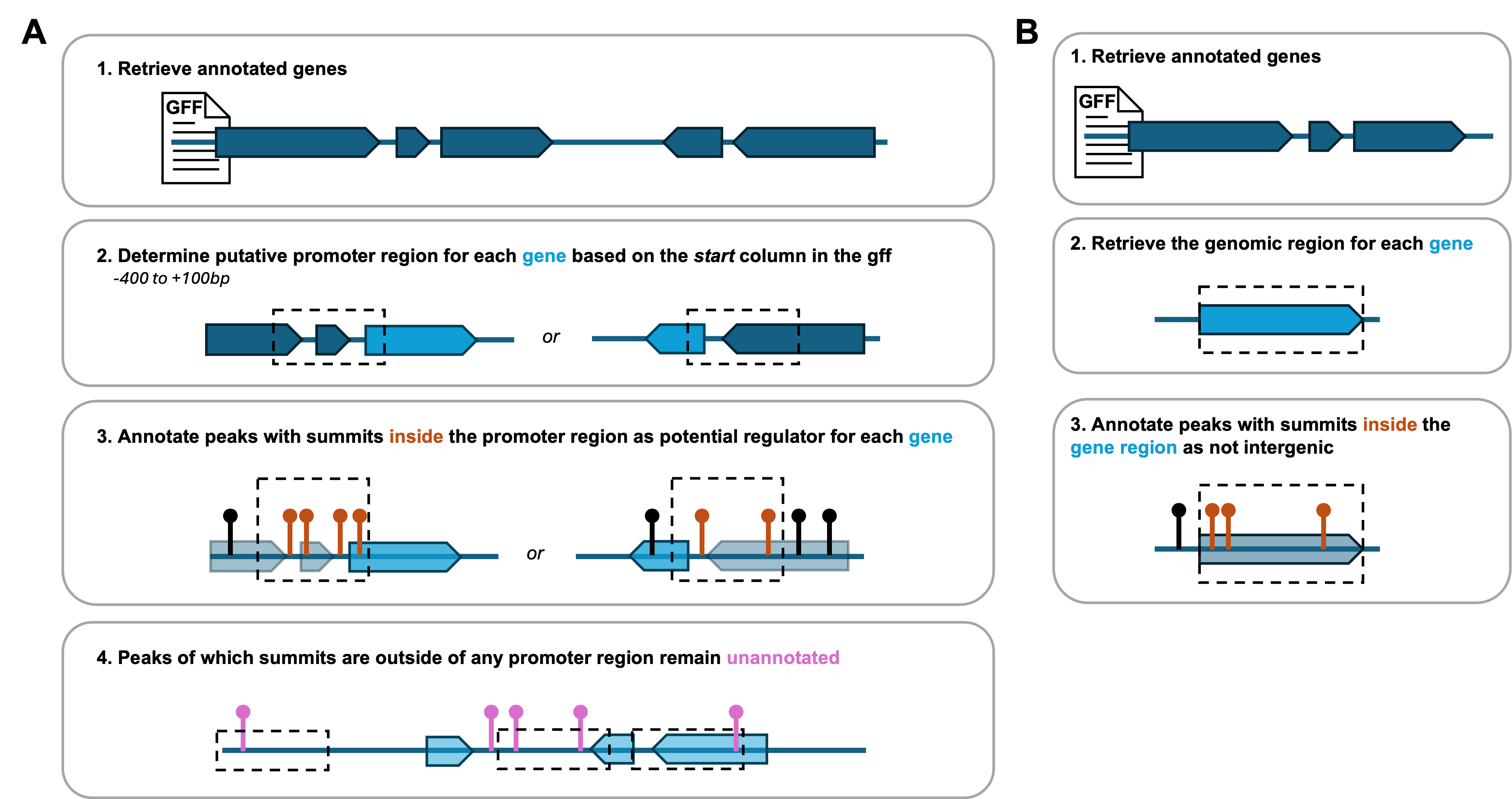
Identification of enriched peaks in the (multi)DAP-sequencing data was done with MACS3 v3.0.0a6 (For more details, see the original paper). Target genes of peaks were determined by comparing the summit location of the peaks and the putative promoter regions of annotated genes (Fig. 1a). Peaks were labelled as intergenic if their summit was located outside of the coding sequence regions of annotated genes (Fig. 1b).
Figure 1 | Schematic overview of peak annotation method based on summit location. A) A peak with summit located in the promoter region of a gene, will be annotated as a binding event for that gene. B) A peak with summit located outside of coding sequence regions of annotated genes, will be labelled as intergenic.
Annotations
Genomic sequences and functional annotations were retrieved from NCBI. Additionally, protein annotations were retrieved from the Gene Ontology Annotation (GOA) database on October 25, 2025 (The Gene Ontology Consortium, 2025): if no protein annotation was present for the specific strain, the closest related strain was selected. The identifiers used for retrieval from these databases have been provided in Table 1. Some functional annotations were manually curated.
Table 1 | Overview of species and their identifiers in databases.
Phylogeny
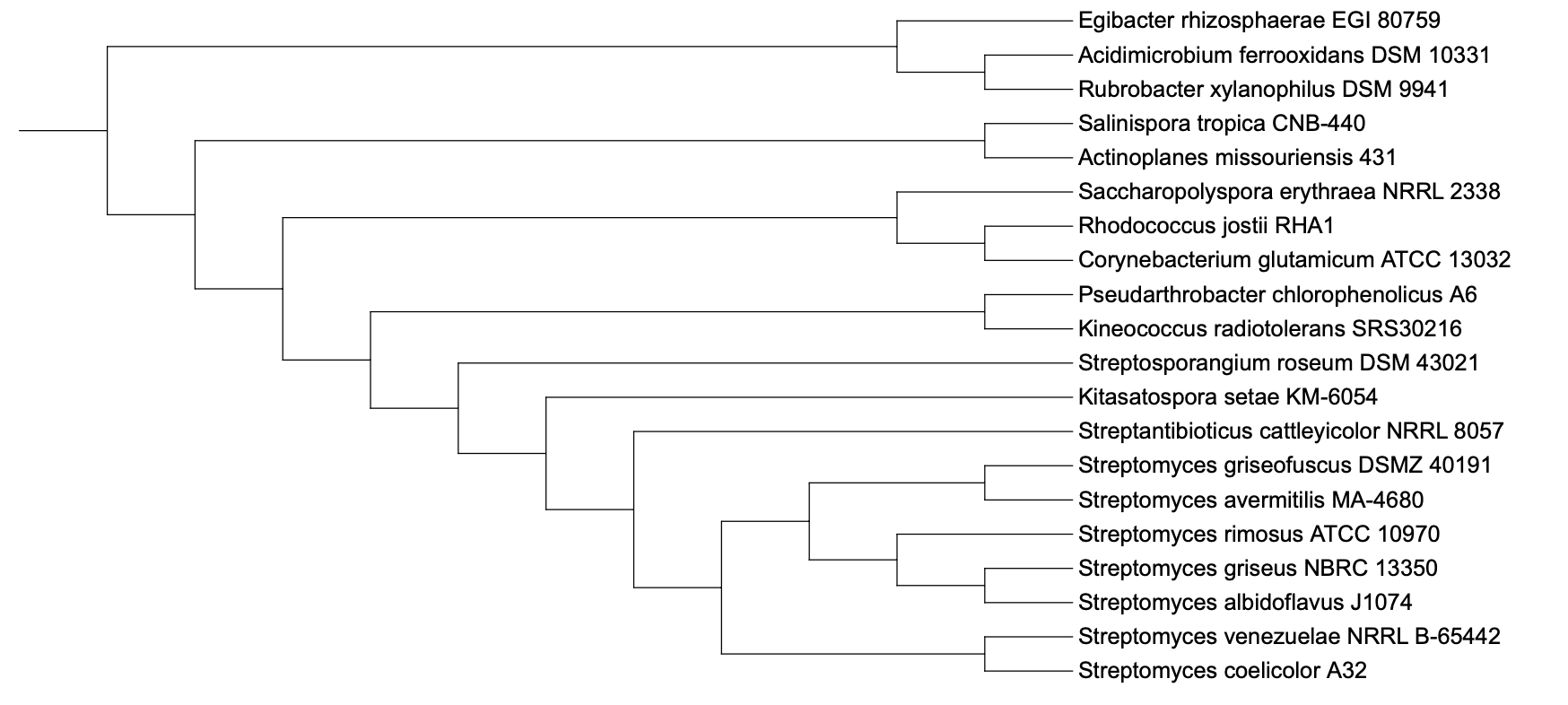
Phylogenetic analysis is described in the original paper. A tree of the 17 actinobacterial species from Table 1 was build, including Egibacter rhizosphaerae EGI80759, Acidimicrobium ferrooxidans DSM 10331, and Rubrobacter xylanophilus DSM 9941 as outgroup (Fig. 2).
Figure 2 | Phylogenetic tree of the species in the multiDAP-seq dataset.
Orthology analysis
To determine the conservation of binding events in this web portal, three gene orthology prediction tools were used: OrthoFinder v2.5.5 (Emms & Kelly, 2019), Proteinortho v6.3.6 (Klemm, et al., 2023), and Proteinortho+PoFF v6.3.6. The genomic sequences of the strains were processed with each tool using default parameters.
Data portal
The data portal is a web application built with the Flask framework and uses custom Python scripts for data processing. Data are stored in a DuckDB database (Raasveldt & Mühleisen, 2019), except for the pileup data: these are stored as bigwig files. Visualisations of results are created with Plotly and Cytoscape. Page layouts and UI components are implemented with Bootstrap, in addition to custom HTML/JavaScript elements.
References
- Augustijn, H. E., Otani, H., Rigolet, A., Stuij, R.,
Pham, V. M., Baumgart, L., Zhang, L., Zhang, Y., Du, C.,
Cernat, S., Rigali, S., O’Malley, R., Medema, M. H.,
Mouncey, N. J., & van Wezel, G. P. (2026).
A global regulatory atlas of Streptomyces reveals conserved and rewired
transcriptional networks across actinomycetes.
[Preprint].
https://doi.org/10.64898/2026.06.06.730586
- Emms, D. and Kelly, S. (2019). OrthoFinder: phylogenetic orthology inference for comparative genomics. Genome Biology 20: 238 DOI: 10.1186/s13059-019-1832-y
- Klemm, P., Stadler, P. F., & Lechner, M. (2023). Proteinortho6: Pseudo-reciprocal best alignment heuristic for graph-based detection of (co-)orthologs. Frontiers. DOI: 10.3389/fbinf.2023.1322477
- Raasveldt, M., & Mühleisen, H. (2019). DuckDB: an Embedabble Analytical Database. Proceedings of the 2019 International Conference on Management of Data, 1981–1984. DOI: 10.1145/3299869.3320212
- The Gene Ontology Consortium (2025). The Gene Ontology knowledgebase in 2026. Nucleic Acids Res. DOI: 10.1093/nar/gkaf1292